🚨 Inland Volusia; Orange; Seminole; Osceola; Okeechobee; Inland Northern Brevard; Inland Indian River; Inland St. Lucie; Inland Martin; Inland Southern Brevard: Wind Advisory issued October 27 at 1:28AM EDT until October 27 at 8:00PM EDT by NWS Melbourne FL 🚨 Coastal Volusia; Coastal Indian River; Coastal St. Lucie; Coastal Martin; Mainland Northern Brevard; Northern Brevard Barrier Islands; Mainland Southern Brevard; Southern Brevard Barrier Islands: Wind Advisory issued October 27 at 1:28AM EDT until October 27 at 8:00PM EDT by NWS Melbourne FL 🚨 Metro Palm Beach County; Metro Broward County; Metropolitan Miami Dade; Coastal Palm Beach County; Coastal Broward County; Coastal Miami Dade County: Wind Advisory issued October 27 at 1:25AM EDT until October 27 at 8:00PM EDT by NWS Miami FL 🚨 Montgomery: None 🚨 Biscayne Bay; Coastal waters from Jupiter Inlet to Deerfield Beach FL out 20 NM; Coastal waters from Deerfield Beach to Ocean Reef FL out 20 NM; Waters from Jupiter Inlet to Deerfield Beach FL from 20 to 60 NM; Waters from Deerfield Beach to Ocean Reef FL from 20 to 60 NM excluding the territorial waters of Bahamas: Gale Warning issued October 27 at 1:23AM EDT until October 28 at 8:00AM EDT by NWS Miami FL 🚨 Biscayne Bay; Coastal waters from Jupiter Inlet to Deerfield Beach FL out 20 NM; Coastal waters from Deerfield Beach to Ocean Reef FL out 20 NM; Waters from Jupiter Inlet to Deerfield Beach FL from 20 to 60 NM; Waters from Deerfield Beach to Ocean Reef FL from 20 to 60 NM excluding the territorial waters of Bahamas: Small Craft Advisory issued October 27 at 1:23AM EDT until October 28 at 8:00PM EDT by NWS Miami FL 🚨 Lake Okeechobee; Coastal waters from Chokoloskee to Bonita Beach FL out 20 NM; Coastal waters from East Cape Sable to Chokoloskee FL out 20 NM; Waters from Chokoloskee to Bonita Beach FL from 20 to 60 NM: Small Craft Advisory issued October 27 at 1:23AM EDT until October 28 at 8:00PM EDT by NWS Miami FL 🚨 Coastal Palm Beach County: Coastal Flood Warning issued October 27 at 1:22AM EDT until October 28 at 8:00PM EDT by NWS Miami FL 🚨 Coastal Broward County; Coastal Miami Dade County: Coastal Flood Warning issued October 27 at 1:22AM EDT until October 28 at 8:00PM EDT by NWS Miami FL 🚨 Coastal Palm Beach County: High Surf Advisory issued October 27 at 1:22AM EDT until October 28 at 8:00PM EDT by NWS Miami FL
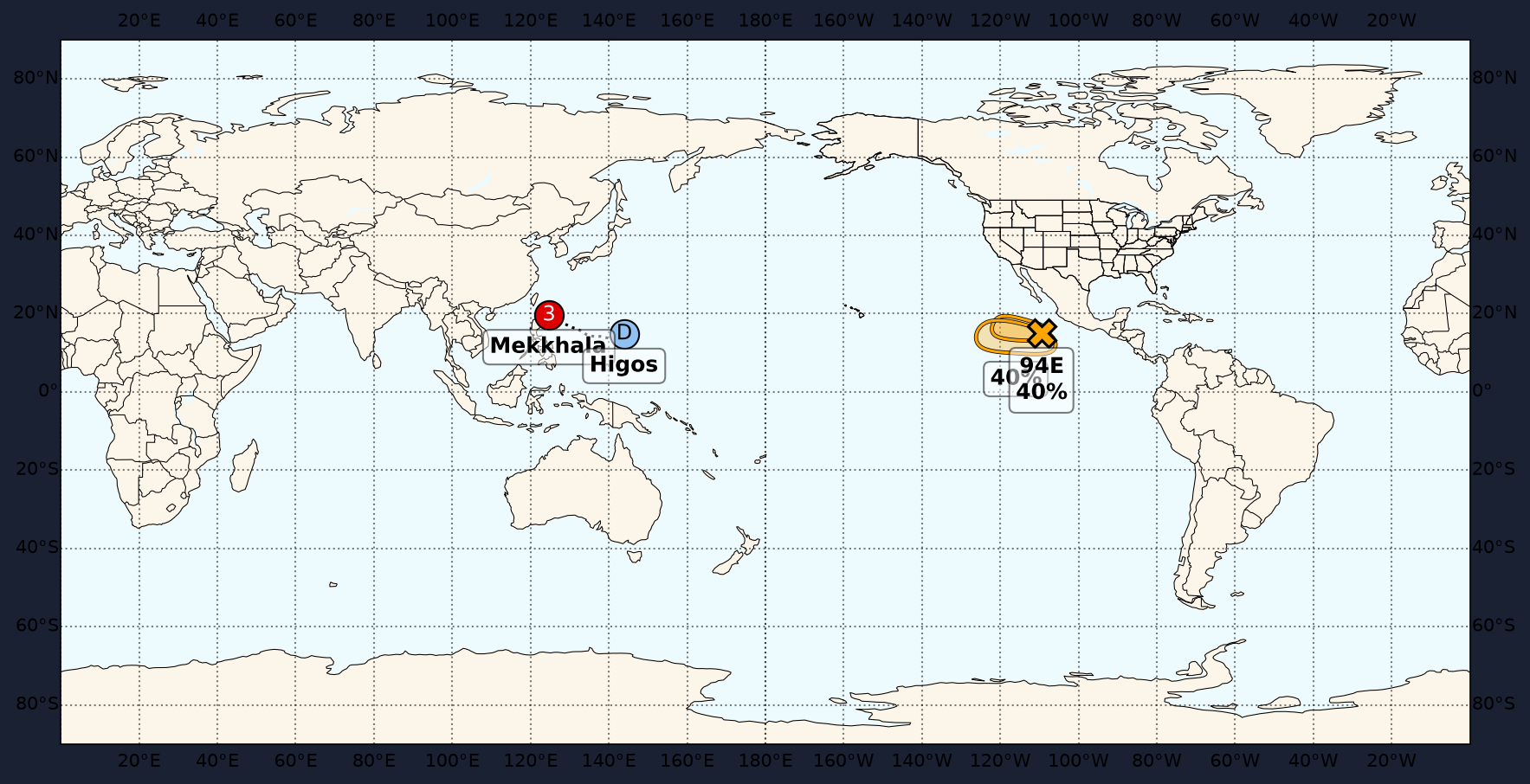
Active Tropical Systems & Formation Outlook
A whole-basin summary of all active tropical cyclones and the NHC
Tropical Weather Outlook, generated with the
tropycal
package. Select a storm below for its official forecast and model guidance.
ZCZC MIATCDEP2 ALL
TTAA00 KNHC DDHHMM
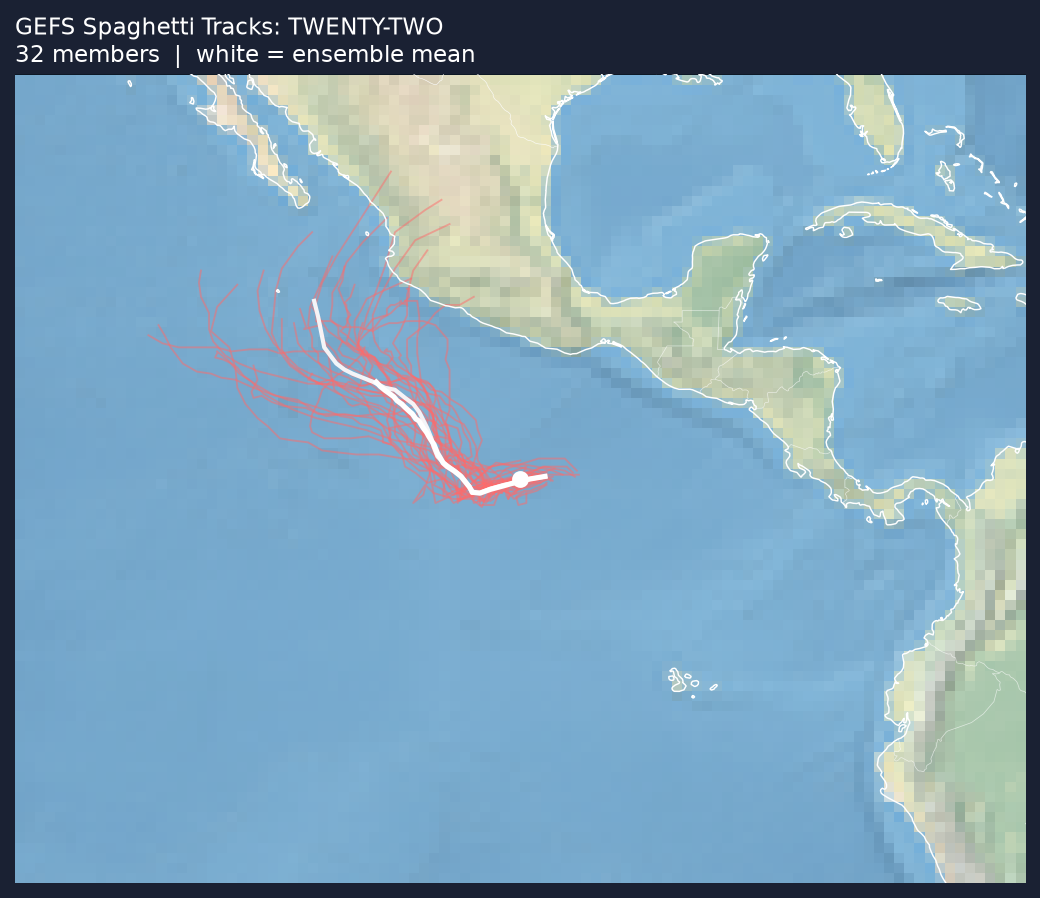
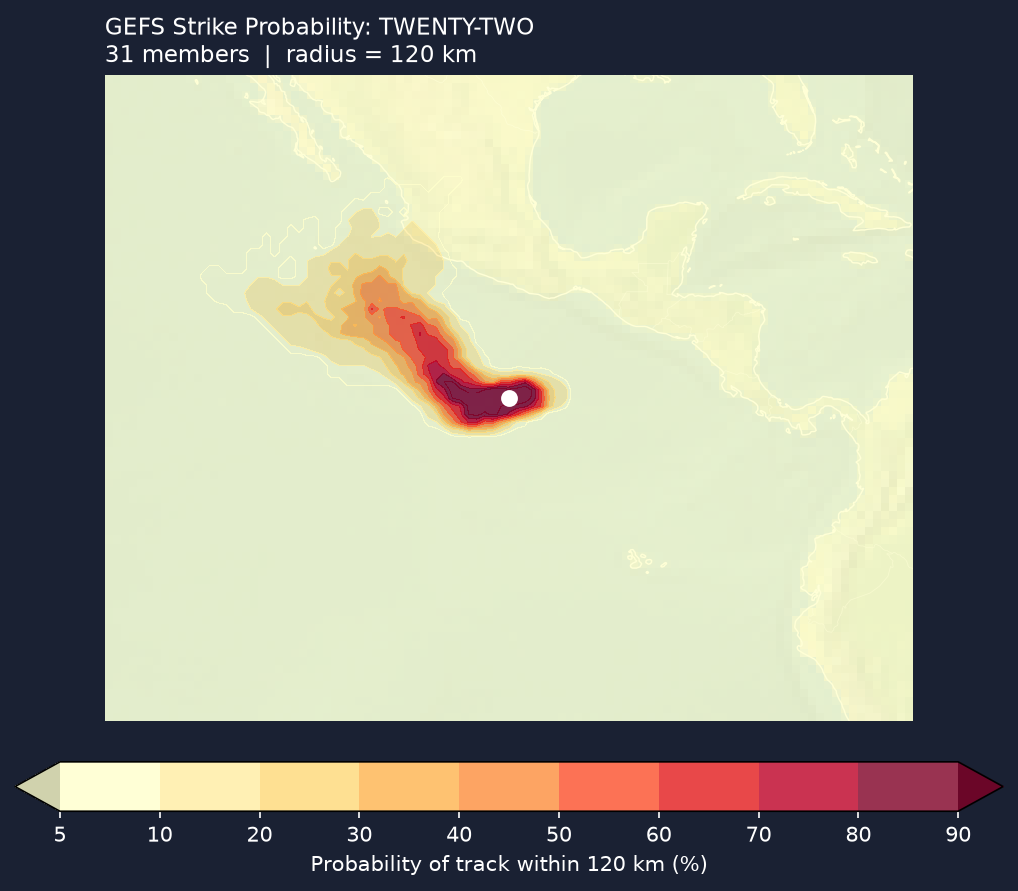
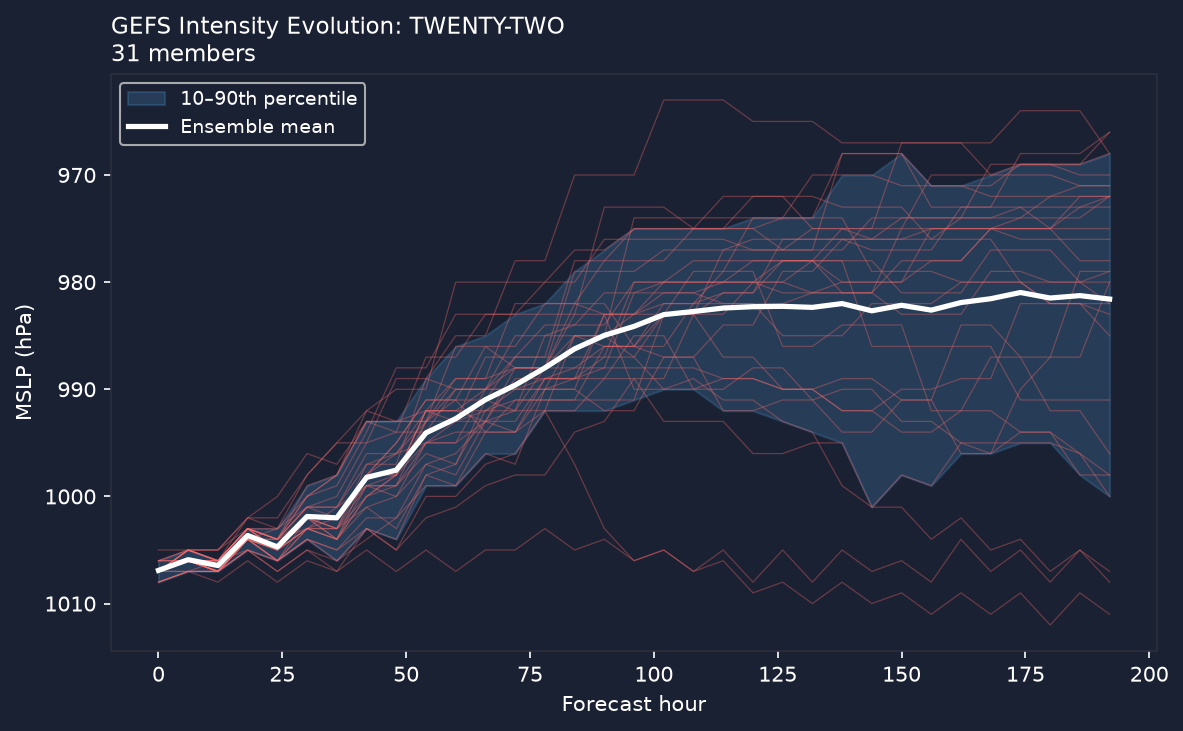
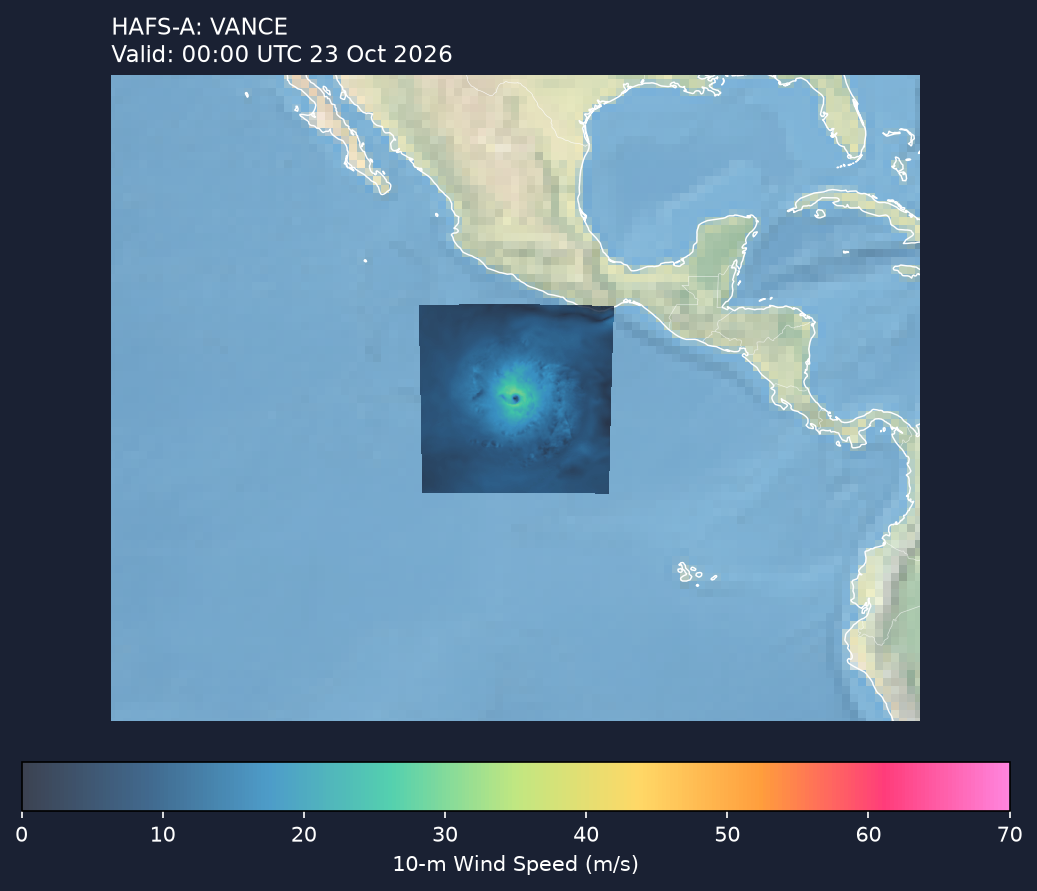
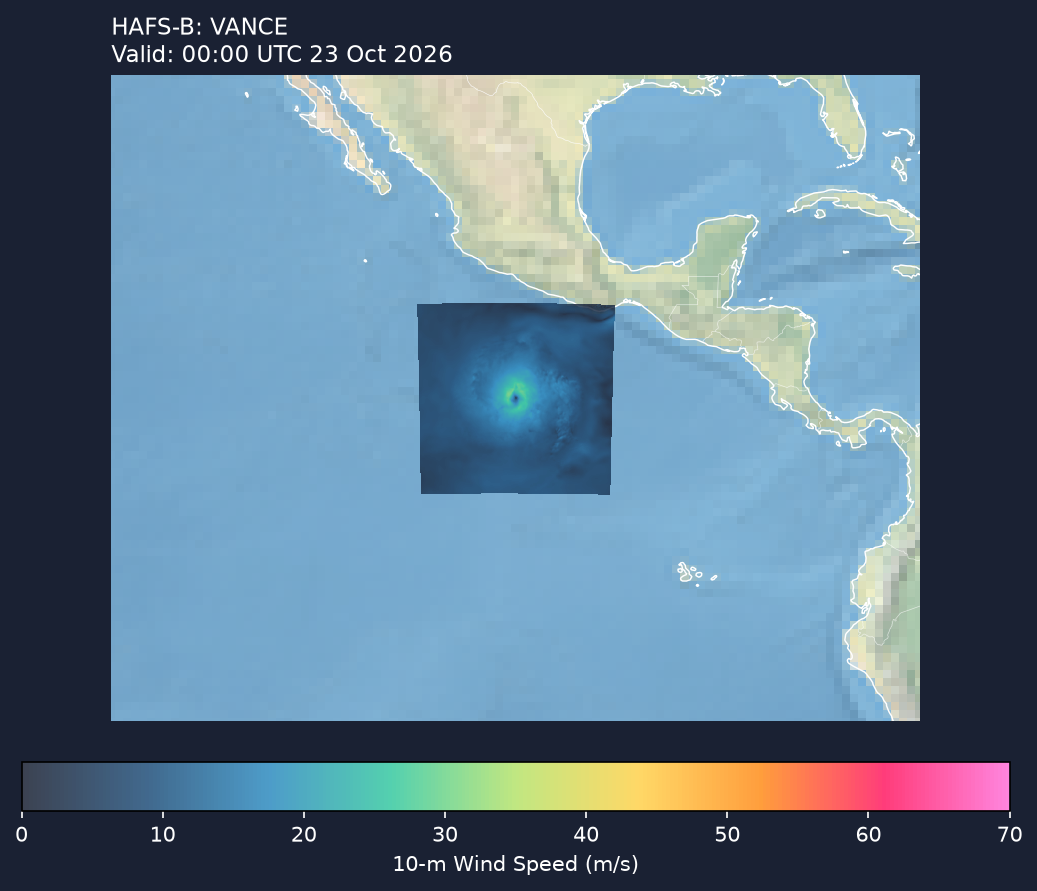
Tropical Storm Vance Discussion Number 23
NWS National Hurricane Center Miami FL EP222026
800 PM MST Mon Oct 26 2026
The structure of Vance has degraded significantly over the last
several hours as the center of the cyclone has become separated from
the convection as seen on visible satellite imagery. Based on a
combination of the subjective and objective intensity estimates, the
initial intensity has been lowered to 45 kt.
Vance has continued to move slowly to the west, 275/4 kt. The
tropical storm is expected to make a turn to west-northwest or
northwest over the next 24 h due to a weak mid-level ridge to the
north of the system. By Wednesday, a broad mid-level trough near the
Baja California Peninsula should force Vance to turn more to the
north. The current NHC track forecast remains in good agreement with
the most recent GDMI and HCCA models. There is still some model
spread in the latter portion of the track forecast, however the
current track still favors a more slower storm motion overall.
Strong westerly to southwesterly wind shear is expected to persist
and increase through the forecast period. However, given the
presence of warm water and sufficient atmospheric moisture, the
cyclone is currently forecast to weaken only gradually over the next
several days. The intensity forecast remains on the upper end of the
guidance and brings Vance to a post-tropical cyclone around 72
hours, as the convection will likely be sheared off by the
aforementioned trough by that time. It should be noted that it is
possible the system could degenerate into a remnant low sooner than
currently forecast, however, GFS and ECMWF simulated satellite
guidance indicates that intermittent convective bursts could still
occur near the center during the next few days.
Key Messages:
1. Periods of heavy rainfall associated with Vance will impact
portions of western Mexico during much of this week. This rainfall
may produce flooding and mudslides across southern Sinaloa,
southwest Durango, and coastal sections of Nayarit and Jalisco,
especially in areas along steep terrain.
2. Interests in southwest and west-central Mexico should
continue to monitor Vance's progress.
FORECAST POSITIONS AND MAX WINDS
INIT 27/0300Z 15.5N 106.3W 45 KT 50 MPH
12H 27/1200Z 15.9N 107.1W 45 KT 50 MPH
24H 28/0000Z 17.2N 107.9W 40 KT 45 MPH
36H 28/1200Z 18.8N 108.3W 40 KT 45 MPH
48H 29/0000Z 20.5N 108.3W 40 KT 45 MPH
60H 29/1200Z 22.0N 108.1W 35 KT 40 MPH
72H 30/0000Z 23.5N 107.6W 30 KT 35 MPH...POST-TROP/REMNT LOW
96H 31/0000Z...DISSIPATED
$$
Forecaster Katz/Cangialosi
NNNN
Threshold
Probability
× Climatology
20kt/12hr
0%
0.0×
25kt/24hr
0%
0.0×
30kt/24hr
0%
0.0×
35kt/24hr
0%
0.0×
40kt/24hr
0%
0.0×
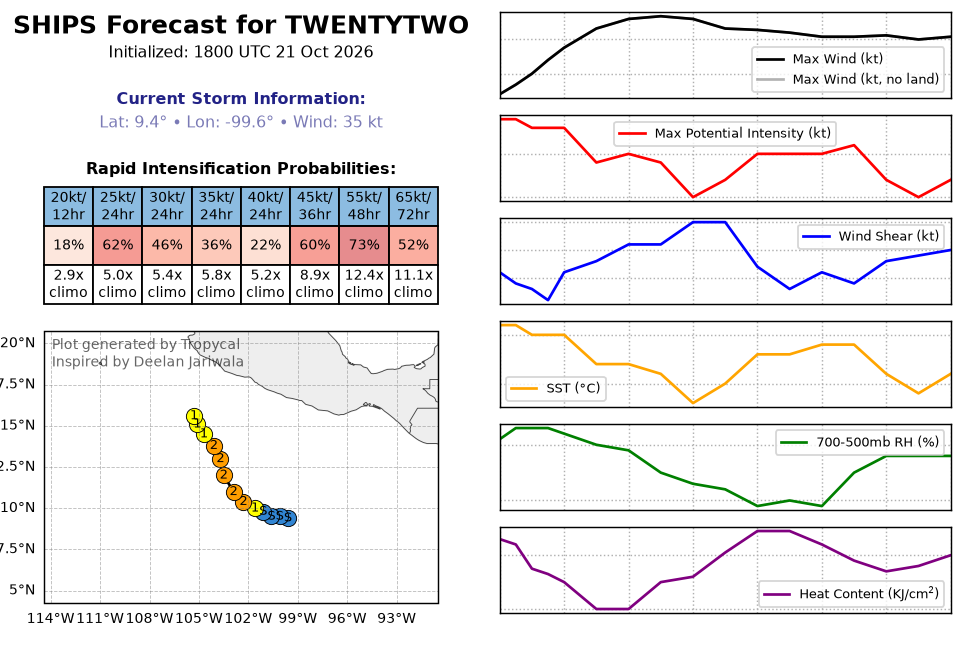
45kt/36hr
0%
0.0×
55kt/48hr
0%
0.0×
65kt/72hr
0%
0.0×
ARNAB
(IO022026)
Type: HUMax Wind: 90 ktMin Pressure: 968 hPaPosition: 16.0, 84.8Basin: North Indian
HAFS and GEFS guidance is only available for storms in the US/NHC domain (Atlantic & East/Central Pacific). For this system, the basin summary and best-track position are shown.
WDIO31 PGTW 270300
MSGID/GENADMIN/JOINT TYPHOON WRNCEN PEARL HARBOR HI//
SUBJ/PROGNOSTIC REASONING FOR TROPICAL CYCLONE 02B (ARNAB) WARNING NR
005//
RMKS/
1. FOR METEOROLOGISTS.
2. 6 HOUR SUMMARY AND ANALYSIS.
SUMMARY:
INITIAL POSITION: 16.0N 84.8E
INITIAL INTENSITY: 90 KTS
GEOGRAPHIC REFERENCE: 445 NM SOUTH-SOUTHWEST OF KOLKATA, INDIA
MOVEMENT PAST 6 HOURS: WESTWARD AT 10 KTS
SIGNIFICANT WAVE HEIGHT: 29 FEET
SATELLITE ANALYSIS, INITIAL POSITION AND INTENSITY DISCUSSION:
ANIMATED MULTISPECTRAL SATELLITE IMAGERY (MSI) DEPICTS TROPICAL
CYCLONE (TC) 02B WITH A WELL-DEVELOPED AND SYMMETRICAL EYE
SURROUNDED BY A COMPACT AND SYMMETRICAL CENTRAL DENSE OVERCAST.
CLOUD TOPS HAVE BEEN WARMING OVER THE PAST FEW HOURS IN ENHANCED
INFRARED IMAGERY BUT THE EXCELLENT SATELLITE PRESENTATION SUGGESTS
THAT INTENSIFICATION IS STILL ONGOING. THE INITIAL POSITION IS
PLACED WITH HIGH CONFIDENCE BASED ON THE EYE IN MSI. THE INITIAL
INTENSITY OF 90 KTS IS ASSESSED WITH MEDIUM CONFIDENCE BASED ON THE
WIDE SPREAD BETWEEN THE AGENCY DVORAK FIXES AND CIMSS OBJECTIVE
INTENSITY ESTIMATES. 90 KTS IS PROBABLY ON THE CONSERVATIVE SIDE
BASED ON THE SATELLITE PRESENTATION. THE ENVIRONMENT IS
CHARACTERIZED AS HIGHLY FAVORABLE, WITH GOOD RADIAL OUTFLOW, WARM
SEA SURFACE TEMPERATURES, AND LOW VERTICAL WIND SHEAR (VWS).
INITIAL WIND RADII BASIS: PERSISTENCE
CURRENT STEERING MECHANISM: SOUTHWESTERN FLANK OF A SUBTROPICAL
RIDGE (STR) CENTERED OVER SOUTHERN CHINA
AGENCY DVORAK AND AUTOMATED FIXES:
PGTW: T4.5 - 77 KTS
DEMS: T4.0 - 65 KTS
CIMSS SATCON: 84 KTS AT 262012Z
CIMSS ADT: 90 KTS AT 270000Z
CIMSS AIDT: 97 KTS AT 270000Z
CIMSS D-MINT: 95 KTS AT 270029Z
CIMSS D-PRINT: 95 KTS AT 262330Z
FORECASTER ASSESSMENT OF CURRENT ENVIRONMENT: HIGHLY FAVORABLE
VWS: 10-15 KTS
SST: 29-30 CELSIUS
OUTFLOW: MODERATE RADIAL
ANALYSIS CONFIDENCE:
INITIAL POSITION: HIGH
INITIAL INTENSITY: MEDIUM
INITIAL WIND RADII: LOW
3. FORECAST REASONING.
SIGNIFICANT FORECAST CHANGES: THERE ARE NO SIGNIFICANT CHANGES TO
THE FORECAST FROM THE PREVIOUS WARNING.
FORECAST DISCUSSION: TC 02B CONTINUES ON A WESTWARD TRACK PRIMARILY
UNDER THE STEERING INFLUENCE OF THE STR POSITIONED TO THE
NORTHEAST. THE STEERING RIDGE IS EXPECTED TO WEAKEN SLIGHTLY AND
SHIFT EASTWARD OVER THE NEXT 24 HOURS, INDUCING A NORTHWARD TURN OF
THE SYSTEM AS IT MAKES LANDFALL JUST AFTER TAU 24. THE TRACK
RETAINS ITS NORTHWARD TRAJECTORY FOR THE REMAINDER OF THE FORECAST
PERIOD. THE INTENSITY FORECAST CALLS FOR CONTINUED INTENSIFICATION
OVER THE NEXT 12 HOURS IN A HIGHLY FAVORABLE ENVIRONMENT. A
WEAKENING TREND BEGINS AROUND TAU 24 AS THE OUTER PERIPHERY OF THE
COMPACT SYSTEM BEGINS TO INTERACT WITH THE INDIAN COAST. RAPID
DECAY OVER LAND WILL BRING DISSIPATION BY TAU 60.
MODEL DISCUSSION: MODEL TRACK GUIDANCE IS IN GOOD AGREEMENT ABOUT
THE WESTWARD TRACK OVER THE BAY OF BENGAL FOLLOWED BY A SHARP
POLEWARD TURN. THE JTWC TRACK FORECAST FOLLOWS THE MULTI-MODEL
CONSENSUS, WHICH IS ALSO TIGHTLY GROUPED WITH THE GOOGLE DEEPMIND
MODELS. A FEW RAPID INTENSITY (RI) AIDS UNSURPRISINGLY TRIGGERED
THIS CYCLE AND THE JTWC INTENSITY FORECAST IS PLACED SLIGHTLY ABOVE
THE CONSENSUS THROUGH TAU 12 IN RESPONSE, THEN FOLLOWS THE
CONSENSUS FOR THE REMAINDER OF THE FORECAST PERIOD. THERE IS SOME
UNCERTAINTY ABOUT JUST HOW HIGH THE INTENSITY CAN CLIMB BEFORE LAND
INTERACTION CAPS IT.
FORECAST CONFIDENCE:
TRACK 00-72 HR: HIGH
INTENSITY 00-72 HR: MEDIUM//
NNNN
HAFS and GEFS guidance is only available for storms in the US/NHC domain (Atlantic & East/Central Pacific). For this system, the basin summary and best-track position are shown.
WDPN31 PGTW 270300
MSGID/GENADMIN/JOINT TYPHOON WRNCEN PEARL HARBOR HI//
SUBJ/PROGNOSTIC REASONING FOR TYPHOON 30W (IN-FA) WARNING NR 015//
RMKS/
1. FOR METEOROLOGISTS.
2. 6 HOUR SUMMARY AND ANALYSIS.
SUMMARY:
INITIAL POSITION: 14.3N 162.4E
INITIAL INTENSITY: 110 KTS
GEOGRAPHIC REFERENCE: 385 NM SOUTHWEST OF WAKE ISLAND
MOVEMENT PAST 6 HOURS: WEST-NORTHWESTWARD AT 02 KTS
SIGNIFICANT WAVE HEIGHT: 36 FEET
SATELLITE ANALYSIS, INITIAL POSITION AND INTENSITY DISCUSSION:
ANIMATED MULTISPECTRAL SATELLITE IMAGERY (MSI) DEPICTS TYPHOON (TY)
30W WITH A DIMPLE EYE FEATURE THAT REMAINS CLOUD FILLED. THE FORWARD
PROGRESS OF THE SYSTEM HAS BEEN STAGNANT AGAIN OVER THE PAST 6 HOURS,
BUT IT HAS MANAGED TO MAINTAIN ITS INTENSITY DESPITE SITTING OVER ITS
OWN COLD WAKE. THE OCEAN HEAT CONTENT (OHC) VALUES OVER 100 KJ PER CM2
ARE LIKELY PREVENTING THE UPWELLING FROM HAVING AN OVERLY DETRIMENTAL
EFFECT ON THE INTENSITY. RADIAL OUTFLOW HAS ALSO REMAINED FAIRLY GOOD,
HELPING TO SUPPORT THE CONSTANT INTENSITY. THE INITIAL POSITION IS
PLACED WITH HIGH CONFIDENCE BASED ON THE DIMPLE EYE FEATURE IN THE MSI
IMAGERY. THE INITIAL INTENSITY OF 110 KTS IS ASSESSED WITH HIGH
CONFIDENCE BASED ON A BLEND OF THE AGENCY DVORAK FIXES ON THE HIGHER
END AND CIMSS OBJECTIVE INTENSITY ESTIMATES ON THE LOWER END. A 262231
METOP-C ASCAT PASS REVEALED A COMPACT GALE FORCE WIND FIELD AND A VERY
COMPACT, HIGH INTENSITY CENTRAL CORE. THE ENVIRONMENT IS CHARACTERIZED
AS FAVORABLE, WITH WARM SEA SURFACE TEMPERATURES, LOW VERTICAL WIND
SHEAR (VWS), AND GOOD RADIAL OUTFLOW. THE ONLY REMAINING NEGATIVE
ENVIRONMENTAL FACTOR IS THE LIKELY EFFECT OF COLD WATER UPWELLING.
INITIAL WIND RADII BASIS: SCATTEROMETER DATA
CURRENT STEERING MECHANISM: COMPETING STEERING ENVIRONMENT BETWEEN
THE SOUTHEASTERN PERIPHERY OF A SUBTROPICAL RIDGE (STR) CENTERED
SOUTH OF HONSHU AND A NEAR-EQUATORIAL RIDGE (NER) TO THE SOUTHEAST
AGENCY DVORAK AND AUTOMATED FIXES:
PGTW: T6.0 - 115 KTS
RJTD: T5.5 - 102 KTS
RCTP: T6.0 - 115 KTS
PHFO: T6.0 - 115 KTS
CIMSS ADT: 107 KTS AT 270000Z
CIMSS AIDT: 108 KTS AT 270000Z
CIMSS D-MINT: 114 KTS AT 262304Z
CIMSS D-PRINT: 104 KTS AT 270030Z
FORECASTER ASSESSMENT OF CURRENT ENVIRONMENT: FAVORABLE
VWS: 5-10 KTS
SST: 29-30 CELSIUS
OUTFLOW: MODERATE RADIAL
OTHER FACTORS: UPWELLING OF COOLER WATER DUE TO THE SLOW TRACK
SPEED
ANALYSIS CONFIDENCE:
INITIAL POSITION: HIGH
INITIAL INTENSITY: HIGH
INITIAL WIND RADII: HIGH
3. FORECAST REASONING.
SIGNIFICANT FORECAST CHANGES: THERE ARE NO SIGNIFICANT CHANGES TO
THE FORECAST FROM THE PREVIOUS WARNING.
FORECAST DISCUSSION: THE TRACK MOTION OF TY 30W CONTINUED AT A SLOW 2
KTS OVER THE PAST 6 HOURS IN A COMPETING STEERING ENVIRONMENT
CHARACTERIZED BY THE SOUTHEASTERN PERIPHERY OF AN STR CENTERED SOUTH
OF HONSHU AND A NER TO THE SOUTHEAST. AN EXTENSION OF THE STR IS
EXPECTED TO BREAK OFF AND TRANSIT EASTWARD TO THE NORTH OF THE SYSTEM
WHILE THE NER WEAKENS AND MOVES WESTWARD THROUGH THE NEXT 24 TO 36
HOURS. THE TRACK FORECAST DEPICTS A GENERALLY WESTWARD MOTION OVER THE
NEXT 24-36 HOURS BECAUSE OF THE STEERING ENVIRONMENT, THEN MODESTLY
ACCELERATES TO MORE TYPICAL SPEEDS THROUGH TAU 96. AFTER TAU 96, TY
30W IS EXPECTED TO APPROACH A WEAK STEERING PATTERN AND SLOW DOWN
AGAIN THROUGH THE REMAINDER OF THE FORECAST PERIOD. THE LATTER WEAK
STEERING ENVIRONMENT BEGINS TO INTRODUCE SOME UNCERTAINTY IN THE TRACK
FORECAST DURING THE LATE TAUS. THE INTENSITY FORECAST NO LONGER
INCLUDES A SHORT-TERM WEAKENING TREND GIVEN HOW WELL THE SYSTEM HAS
MAINTAINED ITS INTENSITY WHILE MOVING SO SLOWLY. THE ENVIRONMENT IS
EXPECTED TO REMAIN GENERALLY FAVORABLE THROUGHOUT THE FORECAST PERIOD
AND STEADY INTENSIFICATION IS FORECAST THROUGH TAU 48, THEN LEVEL OFF
AROUND 130 KTS. A WEAKENING TREND BEGINS AFTER TAU 72, WHERE OHC
VALUES AND INTERNAL DYNAMICS OF THE SYSTEM, WITH…
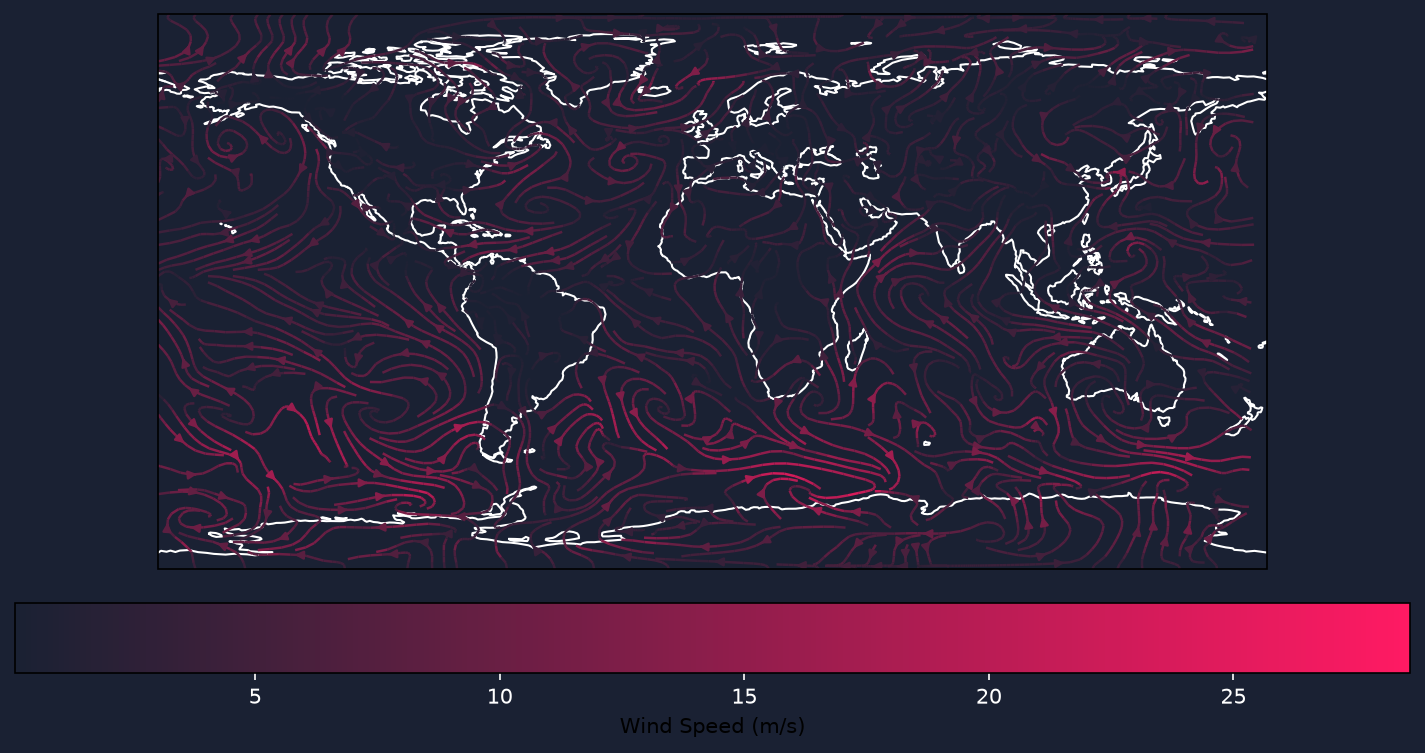
ECMWF 10-m Streamlines
This map visualizes near-surface winds from the ECMWF operational model using streamlines — continuous curves that show the direction of the wind at every point. Streamlines help us visually detect patterns of atmospheric flow, such as jets, troughs, and areas of rotation.
Forecasters at the NHC monitor 10-meter wind fields for signs of a closed low-level circulation — a common feature of early tropical cyclone formation. When streamlines wrap into a tight, circular pattern and form a closed loop, it may signal that a system is transitioning from a disorganized disturbance into a structured cyclone.
This early organization of wind flow is a key threshold in classifying an area as a potential tropical cyclone. While other ingredients like convection and mid-level humidity are also necessary, closed low-level circulation is often the first structural milestone forecasters look for.
Look for small, circular loops in the streamlines over oceanic regions — especially where other environmental factors also align for storm formation.
ECMWF Predictions
No active storm found in ECMWF data at this time.
Environmental Indicators
Hypothetical TC Drift Paths
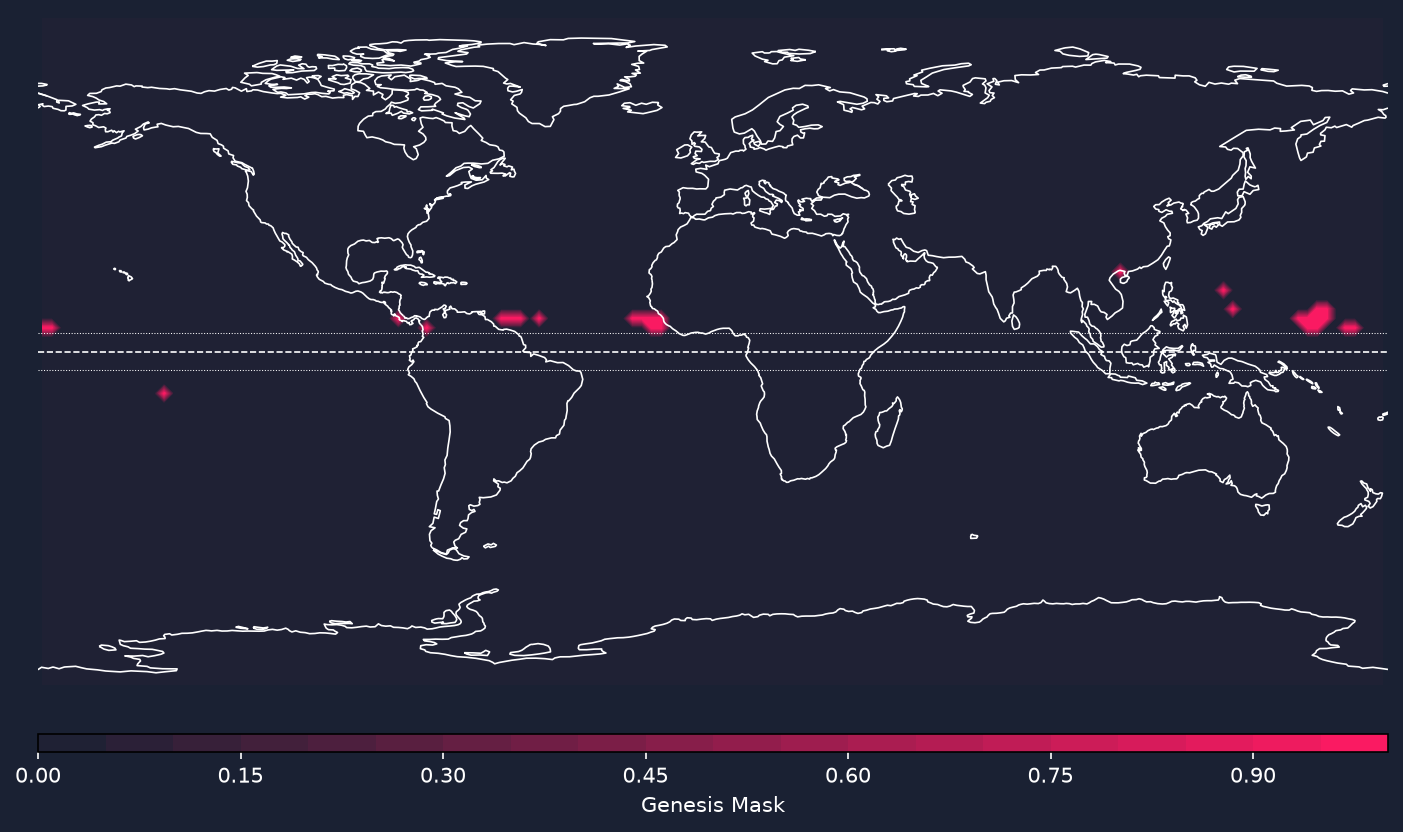
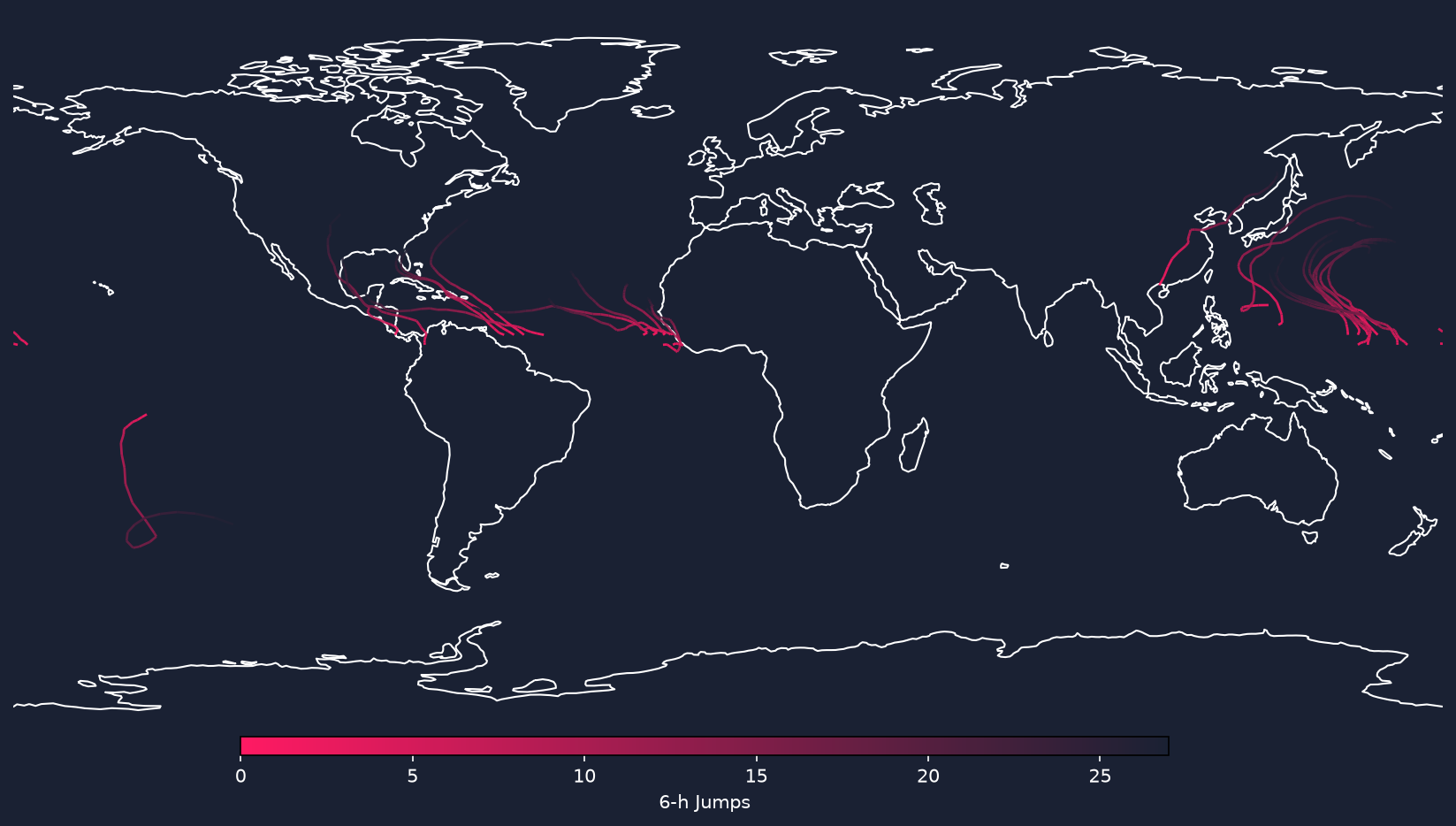
This map displays hypothetical tropical cyclone (TC) paths projected from genesis-favorable zones identified by an environmental mask. These paths are computed using the Emanuel Beta and Advection Model, a physically based framework that estimates the motion of nascent cyclones by combining steering-level winds and planetary rotation effects.
The model blends winds from two critical pressure levels — 850 hPa (lower troposphere) and 250 hPa (upper troposphere) — weighted toward the lower level where most of a tropical cyclone's mass resides. It also incorporates a background component associated with beta drift, which arises from the variation of the Coriolis force with latitude.
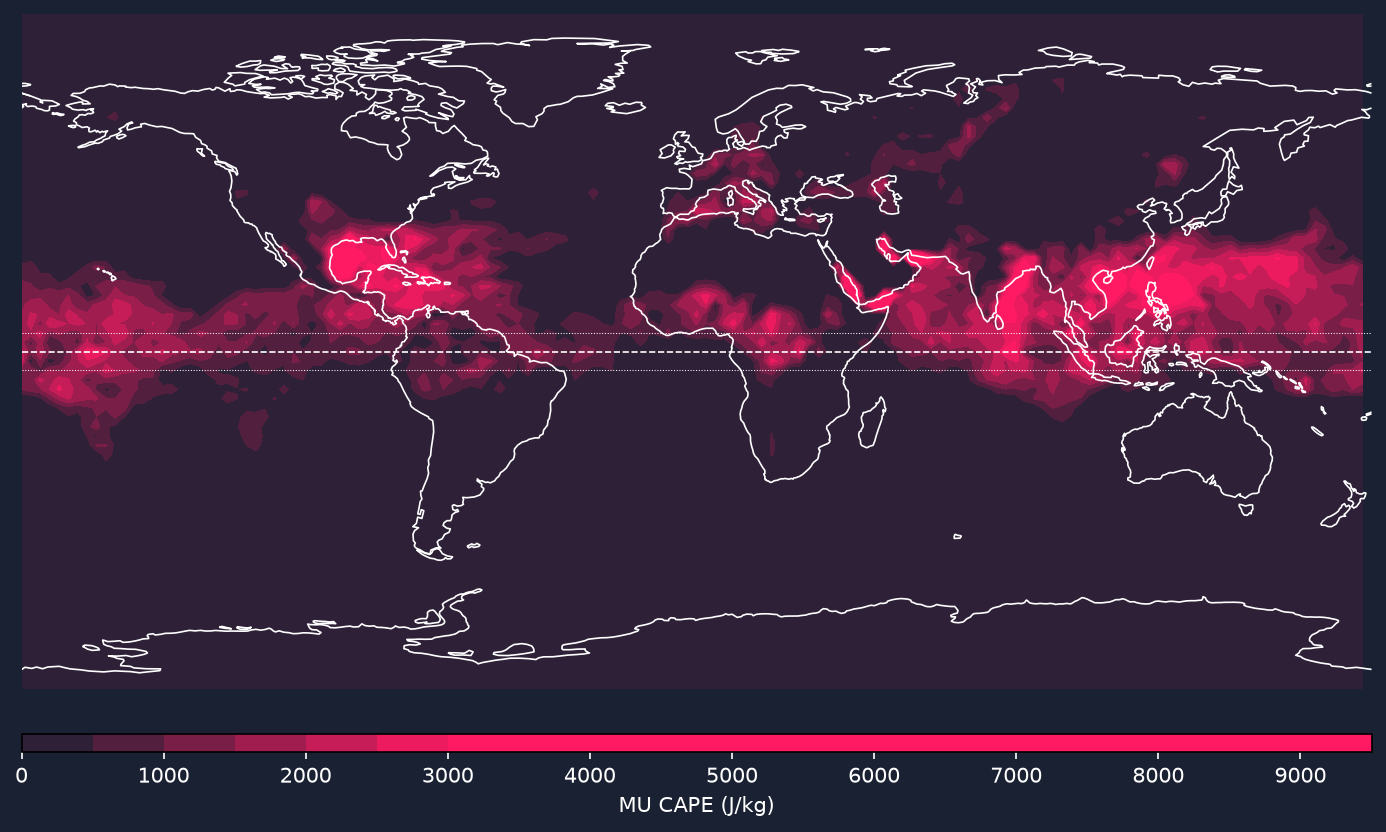
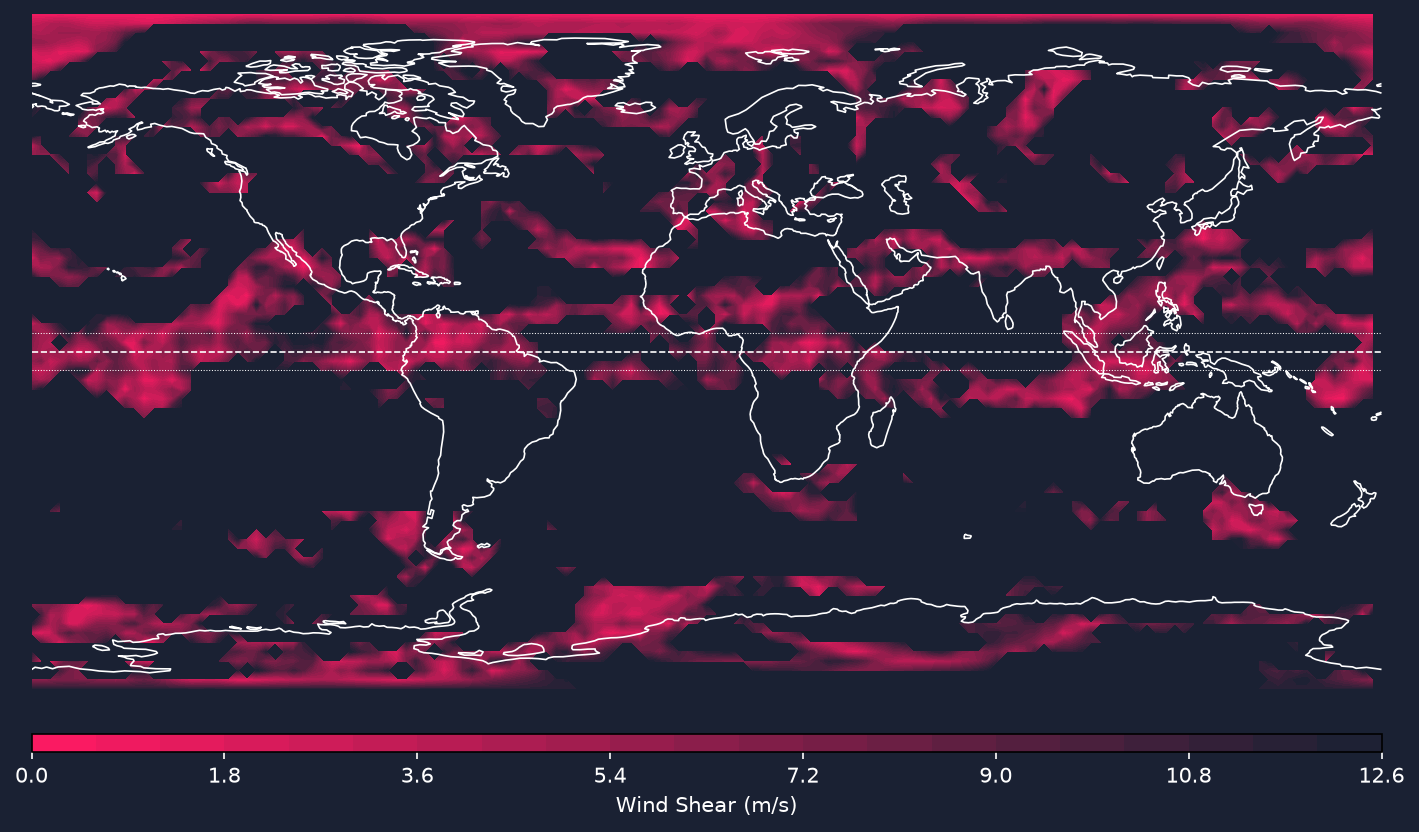
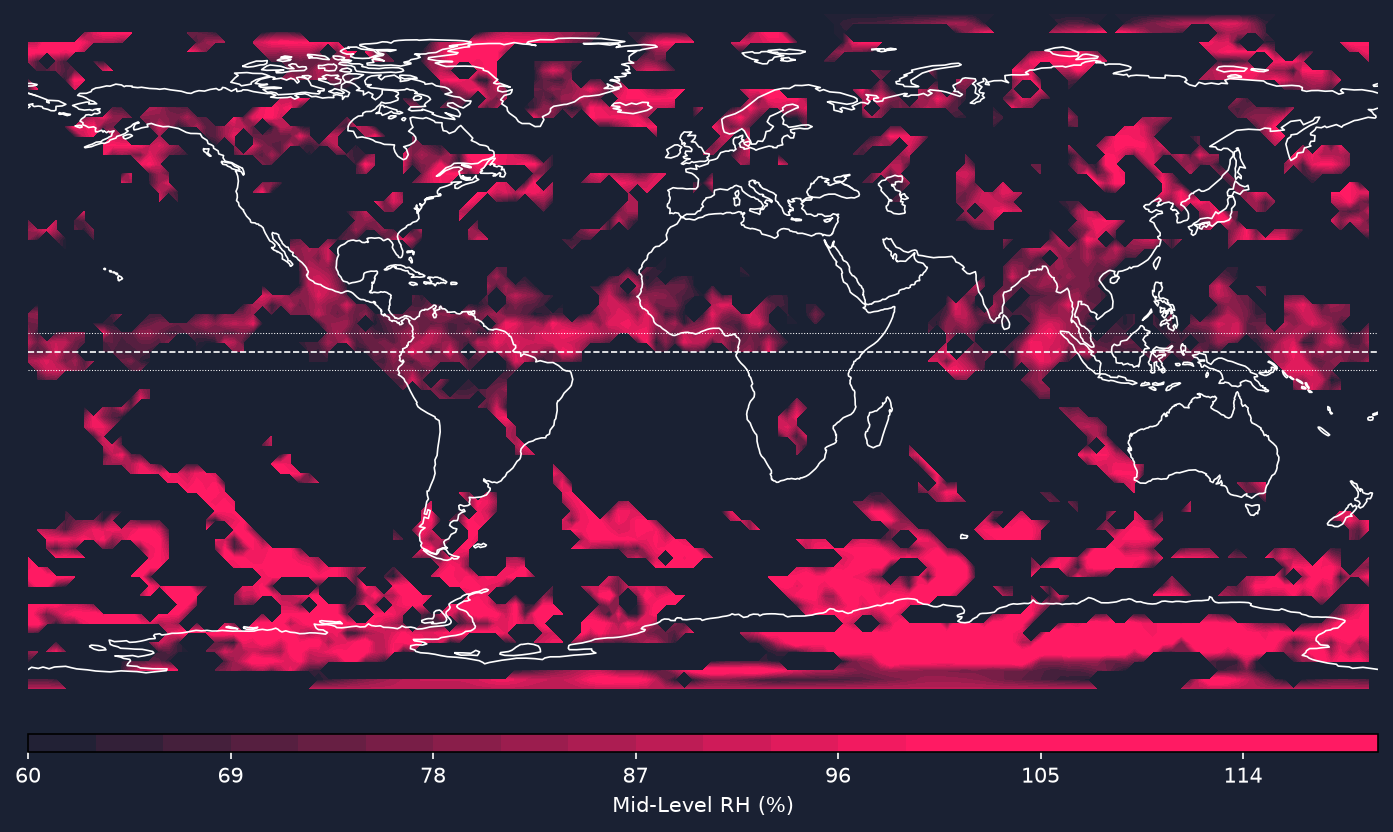
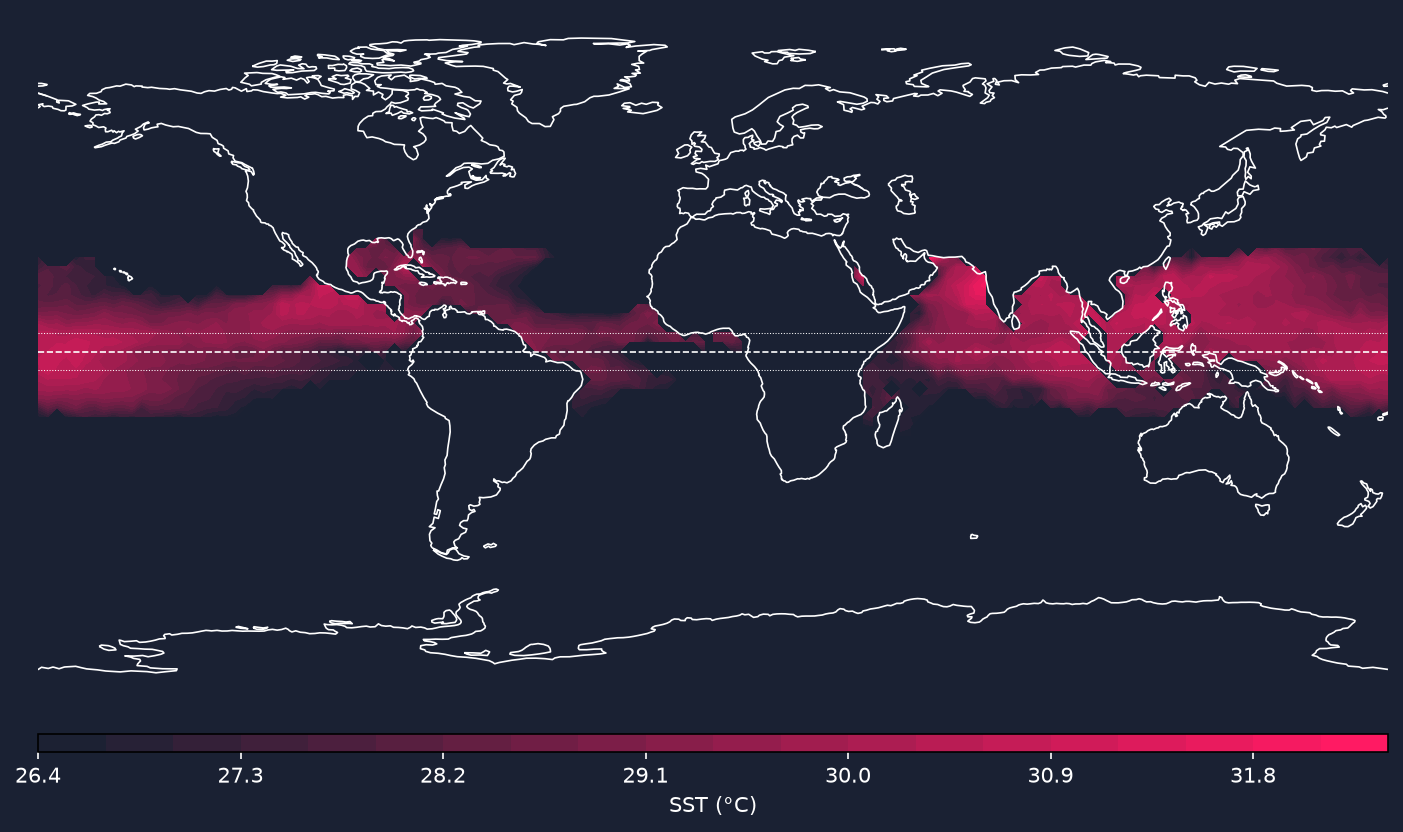
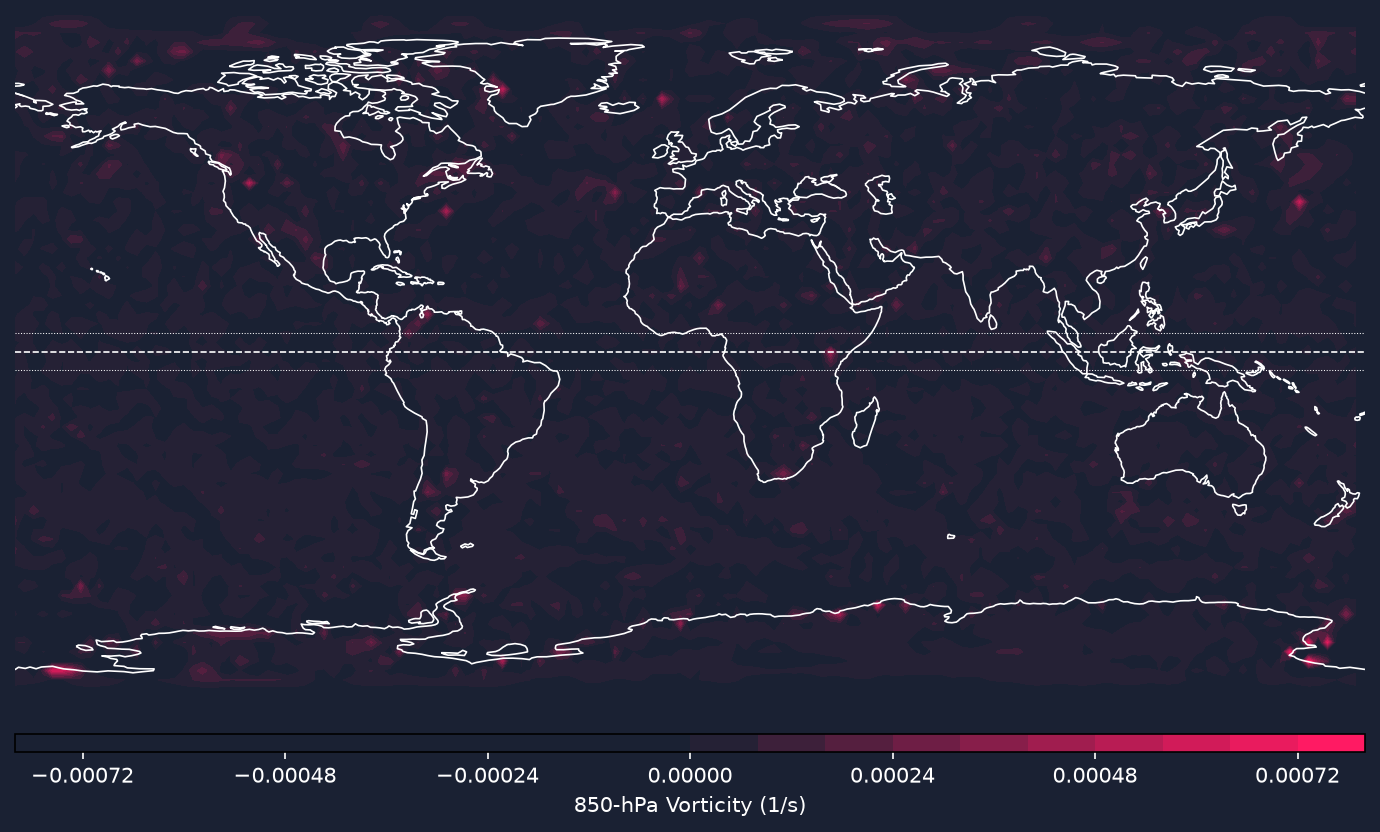
Each pink trajectory represents a storm initialized from a grid cell where all five environmental thresholds were favorable: high CAPE, low vertical wind shear, high mid-level humidity, warm SSTs, and positive low-level vorticity. Arrows darken with time, tracing the cyclone’s evolution in 6-hour steps. These tracks can move over land given the steering winds, but in reality these storms weaken quickly when no longer over warm water. This means the tracks that move over significant would likely die out quickly and are not well represented in this model.
Hypothetical storms often drift westward and poleward, steered by large-scale tropical flow and Earth's rotation — this helps forecasters anticipate where early-stage disturbances might evolve into organized storms.
Pressure & Rainfall (hPa)
This chart shows 24-hour forecasts of surface pressure (in hPa) and precipitation (in mm) for select U.S. cities.
The data comes from the Open-Meteo API,
which sources its predictions from high-resolution numerical weather models like ICON (from the German Weather Service)
and ECMWF's IFS. These are advanced general circulation models (GCMs) that solve physical equations governing the
atmosphere — including thermodynamics, fluid motion, and radiation — to simulate and forecast future states of weather.
A sudden drop in pressure may signal the approach of a developing storm system. Increasing rainfall intensity often
tracks with tropical activity or frontal systems. These paired indicators help visualize evolving atmospheric instability and potential hazards.
NBDC Gulf Buoy Data
This data comes from the National Data Buoy Center (NDBC), a division of NOAA responsible for monitoring ocean
and atmospheric conditions using moored buoys, coastal stations, and drifting floats. These sensors play a vital role in
tracking tropical cyclone development by recording variables like wind speed,
barometric pressure, air & sea surface temperatures, and wave height — all of which
help determine storm structure and intensification.
A sudden drop in sea-level pressure or a spike in wind gusts can signal rapid cyclone strengthening.
Water temperature above ~26°C is a key fuel source for tropical cyclones. Wave and swell height give insight
into the storm’s reach and energy transfer across the ocean. Monitoring these in real time helps improve forecasts and early warnings.
Wind: ENE (70°), 19.4 kt | Gust: 23.3 kt
Pressure: 30.07 | Air Temp: 80.2 °F
Water Temp: 81.0 °F | Dew Point: 72.9 °F
Swell: 5.2 ft | Wind Wave: 3.9 ft
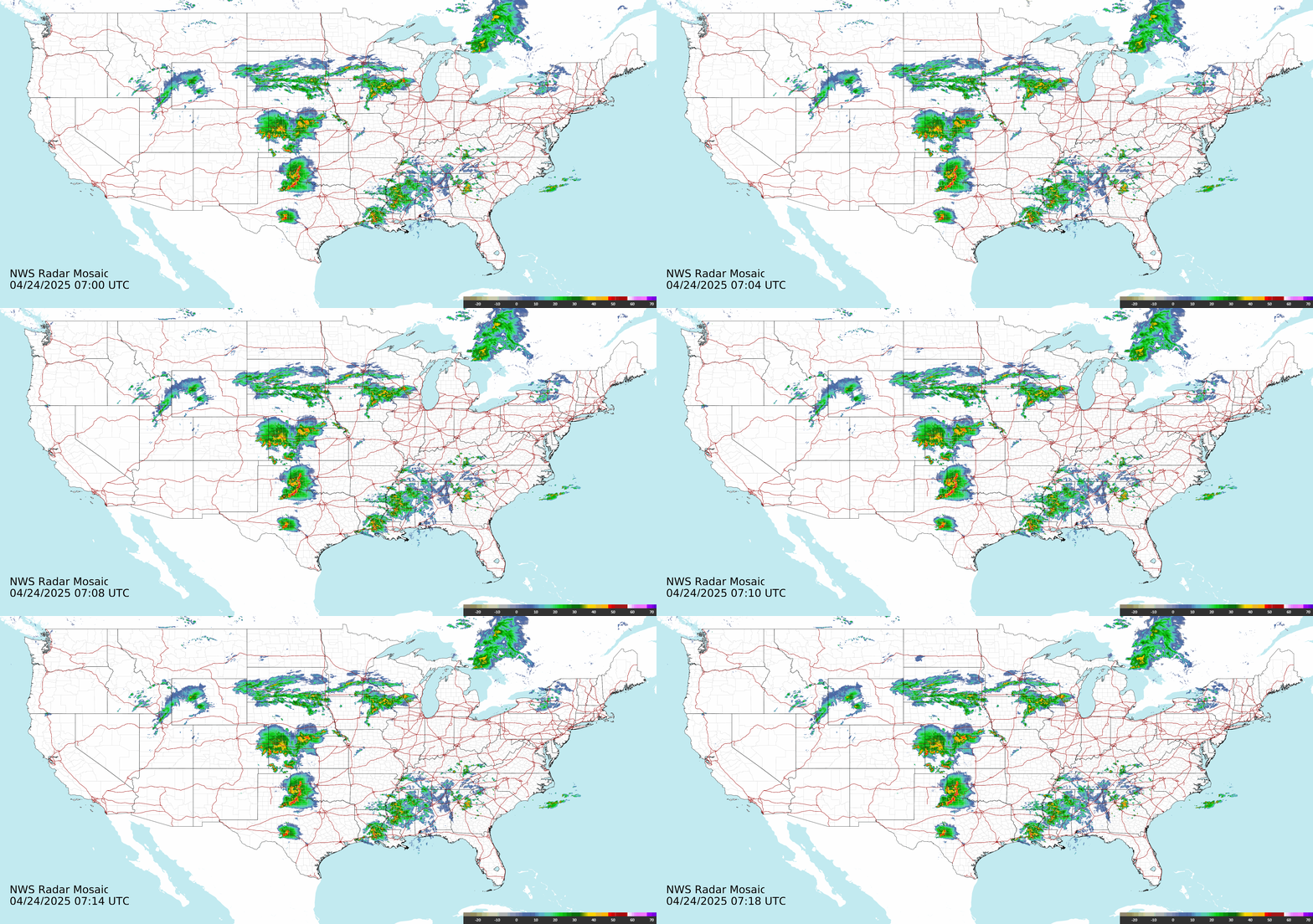
NWS U.S. Radar
The National Weather Service (NWS) collects radar data using the NEXRAD (Next Generation Radar) network —
a nationwide system of over 150 high-resolution Doppler radar stations. Radar works by emitting pulses of energy
that bounce off precipitation (like raindrops, hail, or snow) and return to the radar dish. Doppler radar not only detects the
location and intensity of storms, but also their motion — by measuring shifts in frequency caused by movement of particles toward
or away from the radar site. This allows meteorologists to spot rotating storms and potential tornadoes in real time.
GOES 15-min Satellite
The GOES (Geostationary Operational Environmental Satellite) system is operated by NOAA
and provides continuous weather observation over the Americas. Orbiting 22,300 miles above Earth,
GOES satellites deliver high-resolution imagery every 15 minutes, helping track tropical systems, cloud formation,
and atmospheric motion in real time. The Geocolor imagery shown here combines visible and infrared data
to highlight clouds, land, and sea in a natural-looking format.
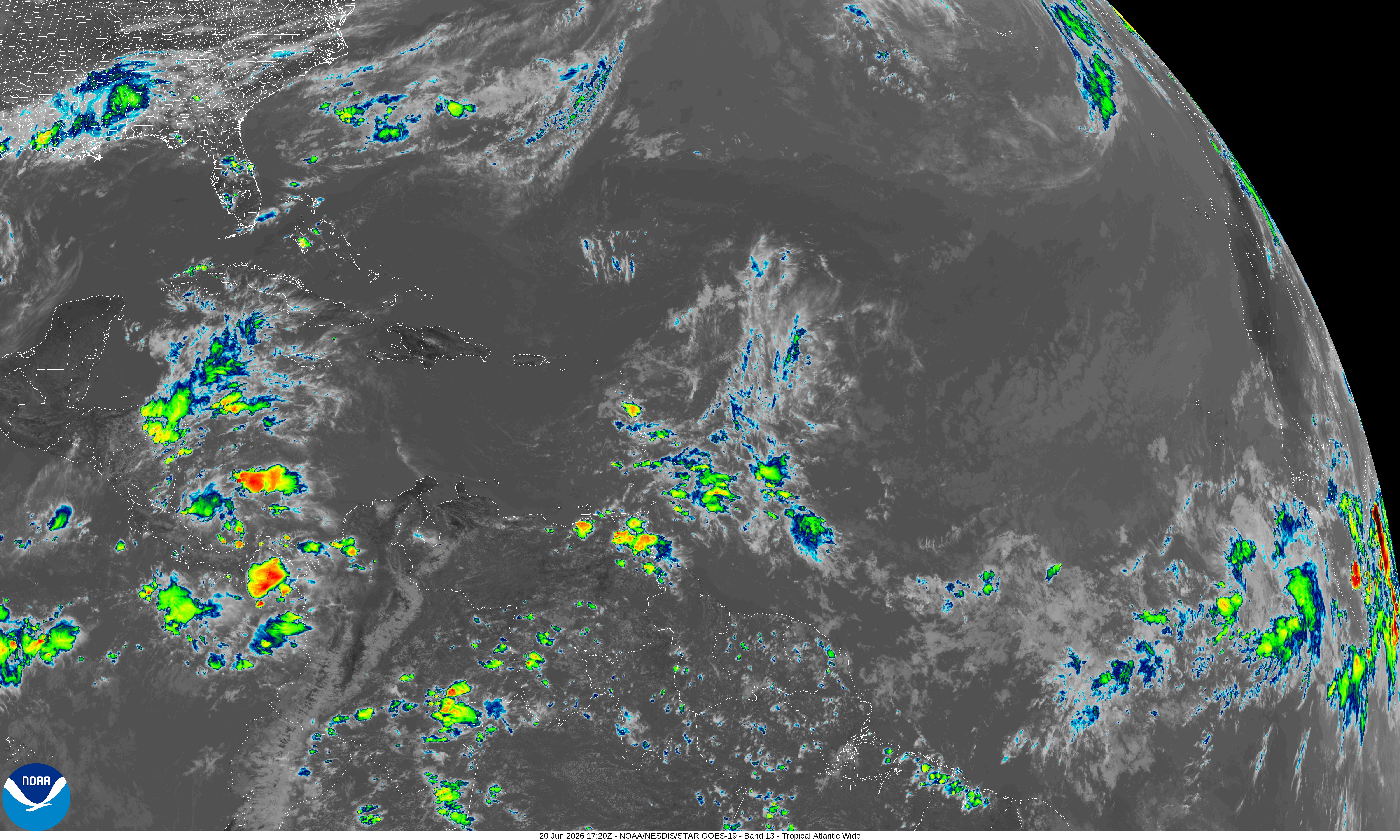
GOES Band 13 – Infrared (IR) Imagery
Band 13 (10.3 µm) is one of the most important infrared channels for tropical meteorology, measuring emitted radiation from cloud tops.
Colder colors (red, yellow) signal deep convection, where strong thunderstorms punch through the upper atmosphere.
These features often indicate the early stages of tropical cyclone formation.
Most recent GOES Band 13 image. Provided by NOAA/NESDIS/STAR.